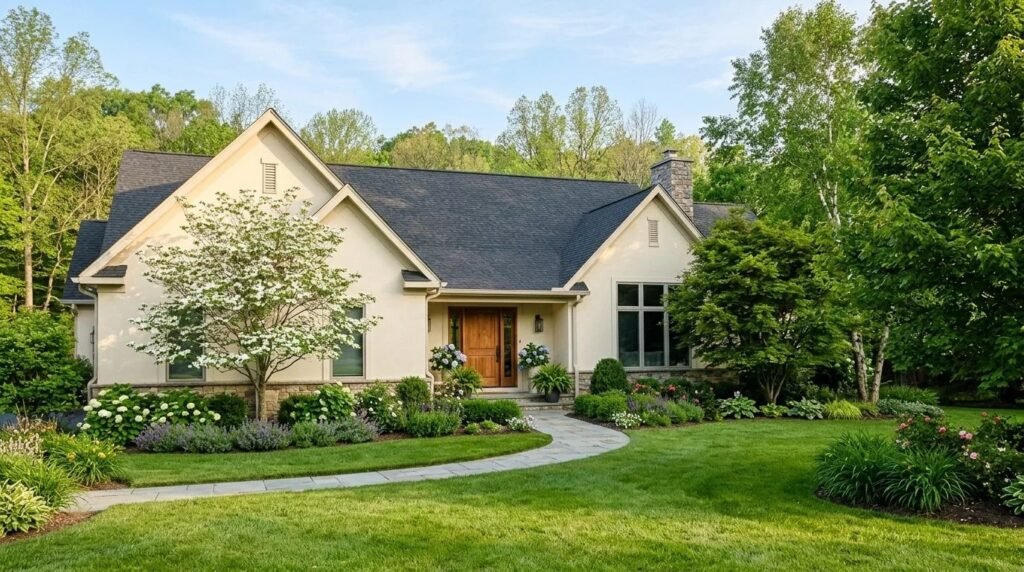
Choosing the right trees to plant near a house can transform an ordinary outdoor space into a beautiful, welcoming landscape. The right tree can add natural color, provide shade during warm weather, improve curb appeal, and create a peaceful garden around your home. Whether you have a small front yard, a spacious backyard, or a narrow planting area beside your house, there are many tree varieties to consider.
However, selecting a tree involves more than choosing one that looks attractive. You need to consider its mature height, canopy spread, root growth, sunlight requirements, soil conditions, and maintenance needs. A tree that looks small when purchased may eventually grow too close to your roof, interfere with paving, or require more space than your garden can provide.
The best trees to plant near a house are those that complement your home’s architecture, thrive in your local climate, and have enough room to grow naturally. Some trees are ideal for colorful flowers, while others are better suited to shade, privacy, evergreen foliage, or edible fruit.
In this guide, we explore 15 attractive tree options, explain what makes each one suitable for residential landscaping, and share practical tips for planting trees safely around your home.
Best Trees to Plant Near House: 15 Beautiful Options
The best tree for your property depends on your available space and landscaping goals. Before making a decision, compare the tree’s mature size, growing requirements, and main benefits.
Here are 15 trees worth considering for residential gardens in suitable climates.
| Tree | Best use | Main benefit |
| Japanese maple | Small ornamental gardens | Colorful foliage |
| Eastern redbud | Front yard landscaping | Spring flowers |
| Flowering dogwood | Compact gardens | Seasonal beauty |
| Crape myrtle | Warm-climate gardens | Long-lasting flowers |
| Star magnolia | Decorative front yards | Early spring blooms |
| Serviceberry | Wildlife-friendly gardens | Flowers, fruit, and fall color |
| Crabapple | Seasonal landscaping | Flowers and ornamental fruit |
| Loquat | Suitable warm climates | Evergreen foliage and fruit |
| American hornbeam | Natural landscaping | Attractive structure |
| American holly | Evergreen screening | Year-round greenery |
| Pawpaw | Suitable temperate gardens | Edible fruit |
| Dwarf citrus | Sunny gardens and patios | Fragrant flowers and fruit |
| Olive tree | Mediterranean-style gardens | Silvery foliage |
| Saucer magnolia | Spacious front gardens | Large ornamental flowers |
| Columnar hornbeam | Narrow planting spaces | Upright growth habit |
Important: These trees are not suitable for every climate. Check the species and cultivar’s mature dimensions, local hardiness, root characteristics, and growing requirements before choosing one for your property.
1. Japanese Maple
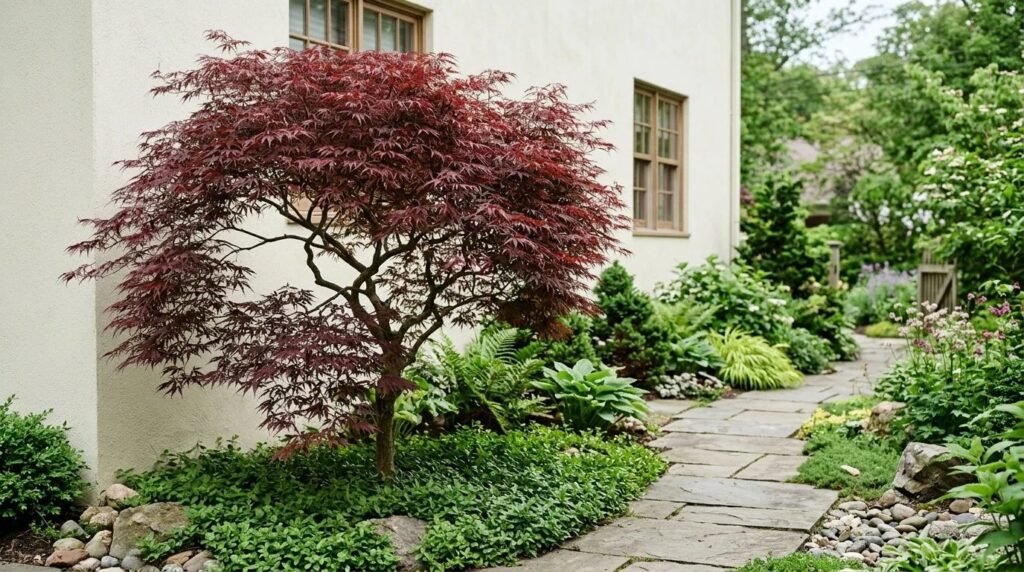
Japanese maple is one of the most attractive choices for homeowners who want a decorative tree without overwhelming their garden. Its delicate leaves, graceful branches, and seasonal colors make it a popular feature in thoughtfully designed residential landscapes.
Depending on the variety, Japanese maple foliage can be green, burgundy, orange, or deep red. Some cultivars develop particularly striking autumn colors, while others maintain attractive foliage throughout the growing season.
This tree works beautifully near a front entrance, beside a garden path, or in a small landscaped bed where its shape can be appreciated. Compact cultivars may also be suitable for large containers.
Why choose Japanese maple?
- Adds color and texture to your landscape.
- Can suit smaller gardens when the right cultivar is selected.
- Complements stone pathways, neutral exterior walls, and contemporary homes.
- Provides attractive foliage during multiple seasons.
Japanese maples generally prefer well-drained soil and protection from harsh afternoon sun, particularly in hot climates. Some varieties tolerate more sunlight than others.
Planting tip: Check the mature height and spread before planting. Avoid locations where reflected heat from walls or paving could cause excessive leaf stress.
2. Eastern Redbud
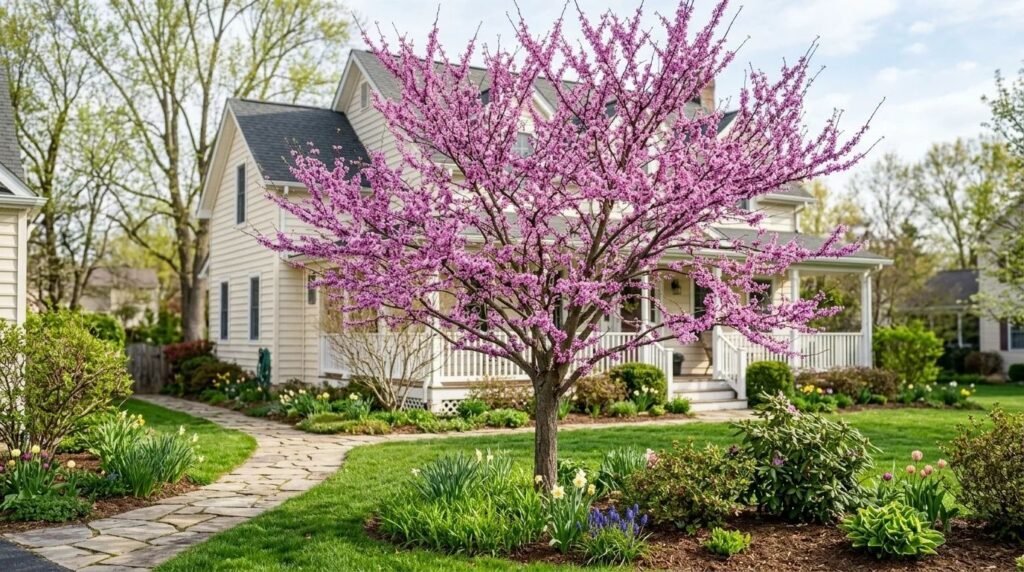
Eastern redbud is an excellent ornamental choice for homeowners who want a colorful spring garden. Its pink or purple-pink flowers often appear along the branches before the leaves emerge, creating a striking seasonal display.
After flowering, heart-shaped green leaves provide an attractive backdrop for other garden plants. Certain cultivars also offer distinctive foliage colors.
Eastern redbud can be used as a focal point in a front yard or planted within a mixed garden bed. Its appearance works particularly well in landscapes that combine flowering shrubs, lawns, and natural stone.
Benefits of Eastern redbud:
- Produces beautiful spring flowers.
- Adds attractive heart-shaped foliage.
- Creates a welcoming focal point near the front of a house.
- Offers seasonal interest without requiring the space of many large shade trees.
This tree generally prefers well-drained soil and adequate moisture while establishing. Its performance varies with climate and growing conditions.
Planting tip: Allow enough space for the mature canopy. Avoid planting it where branches will obstruct walkways or interfere with the house as the tree grows.
3. Flowering Dogwood
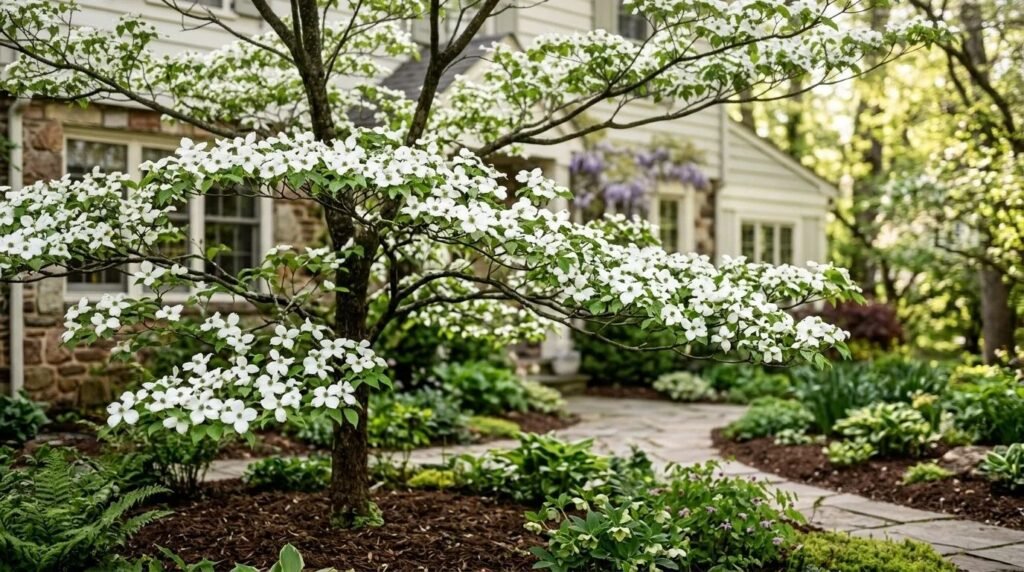
Flowering dogwood is known for its graceful branching, attractive spring blossoms, and seasonal foliage. Depending on the species and cultivar, its flower-like bracts may be white or pink.
The tree’s relatively compact form makes it worth considering for residential landscapes where a large shade tree would occupy too much space. It can be especially attractive in partially shaded gardens with suitable soil conditions.
Why flowering dogwood deserves consideration:
- Provides a beautiful spring display.
- Adds seasonal color to smaller landscapes.
- Can complement traditional and woodland-inspired garden designs.
- Offers attractive foliage and, in some varieties, fruit for wildlife.
Many flowering dogwoods prefer moist, well-drained soil and protection from excessive heat. They may struggle in very hot, dry locations.
Planting tip: Choose a variety suited to your local climate, and leave sufficient room for its mature branches rather than positioning it tightly against the foundation.
4. Crape Myrtle
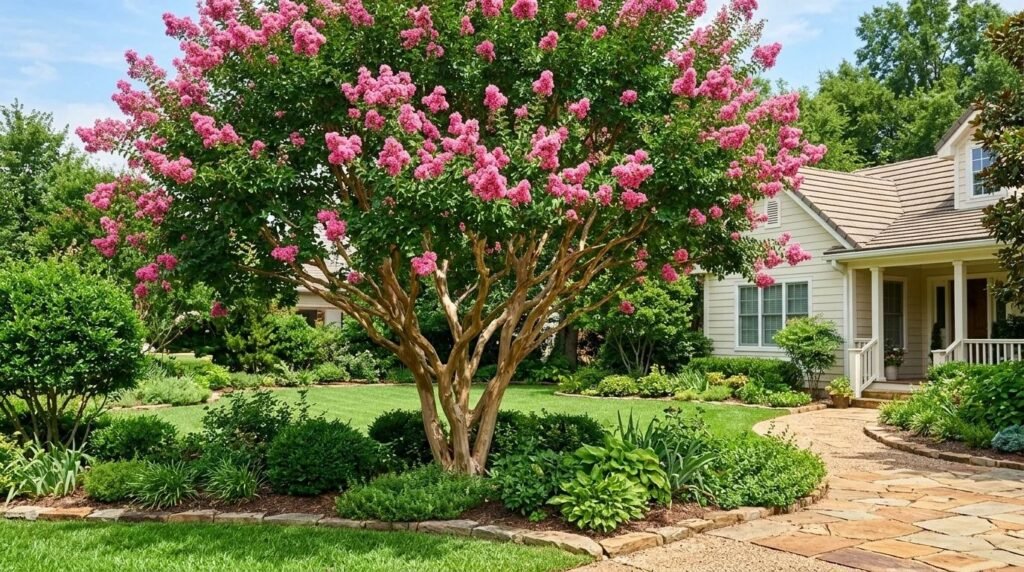
Crape myrtle is a popular choice for warm-climate landscaping because of its colorful flowers and attractive branching structure. Depending on the cultivar, its flowers may be pink, white, red, purple, or lavender.
Some varieties also develop decorative bark that adds interest after the flowering season. With cultivars available in different sizes, crape myrtle can work in a range of residential gardens.
Why plant crape myrtle?
- Produces abundant summer flowers.
- Adds color to front yards and outdoor seating areas.
- Offers attractive bark and branching.
- Includes compact varieties for more limited spaces.
Crape myrtle generally grows best in full sun and well-drained soil. Its suitability depends on the climate and the particular variety.
Planting tip: Select a naturally compact cultivar if you have limited space. Choosing the right mature size is usually better than repeatedly cutting back an oversized tree.
5. Star Magnolia
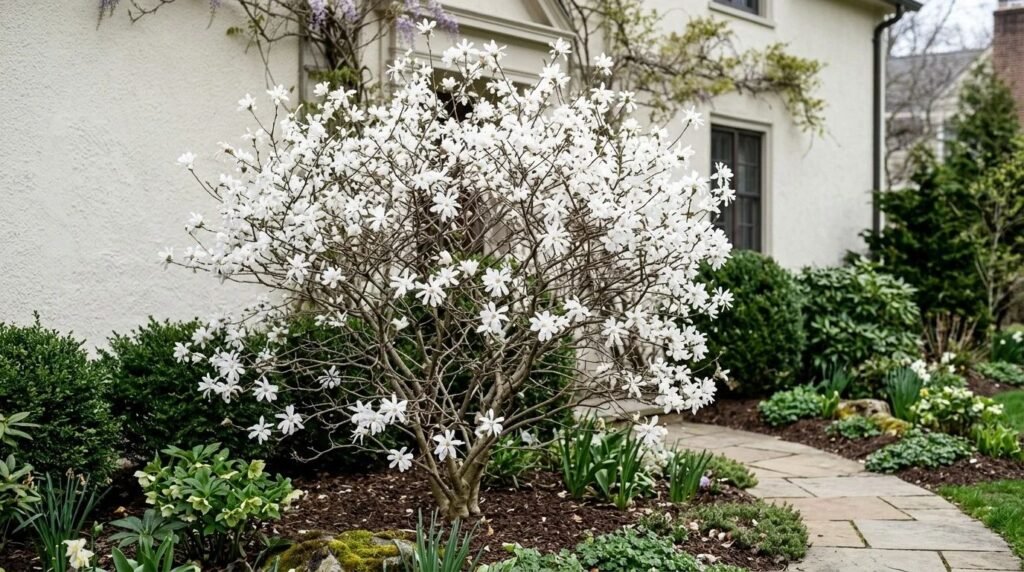
Star magnolia is a decorative tree valued for its star-shaped white or pale pink flowers. These often appear in early spring before the foliage fully develops, making the tree an attractive feature in ornamental gardens.
Its relatively compact growth habit can make it suitable for certain front yards and smaller landscaped spaces. It also pairs well with evergreen shrubs and simple planting beds.
Benefits of star magnolia:
- Produces elegant early-spring flowers.
- Creates a refined focal point.
- Can suit smaller gardens with the right cultivar.
- Complements modern and traditional exterior designs.
Star magnolia generally prefers moist, well-drained soil and suitable sunlight. Late frosts can damage its flowers in some locations.
Planting tip: Consider local frost conditions and leave enough room for the tree’s mature canopy.
6. Serviceberry

Serviceberry is a versatile ornamental tree that provides several seasons of interest. Depending on the species, it produces delicate spring flowers, small fruits, and attractive autumn foliage.
Its fruit may attract birds and other wildlife, making it a useful choice for homeowners who want a garden that supports biodiversity.
Why consider serviceberry?
- Combines flowers, fruit, and seasonal foliage.
- Offers a natural appearance for residential gardens.
- Can attract wildlife.
- Works well in mixed borders and informal landscapes.
Serviceberry generally prefers well-drained soil with adequate moisture. Some varieties are susceptible to pests or diseases under unfavorable conditions.
Planting tip: If you prefer to keep walkways and patios clean, avoid placing fruit-producing trees directly beside heavily used paved areas.
7. Crabapple
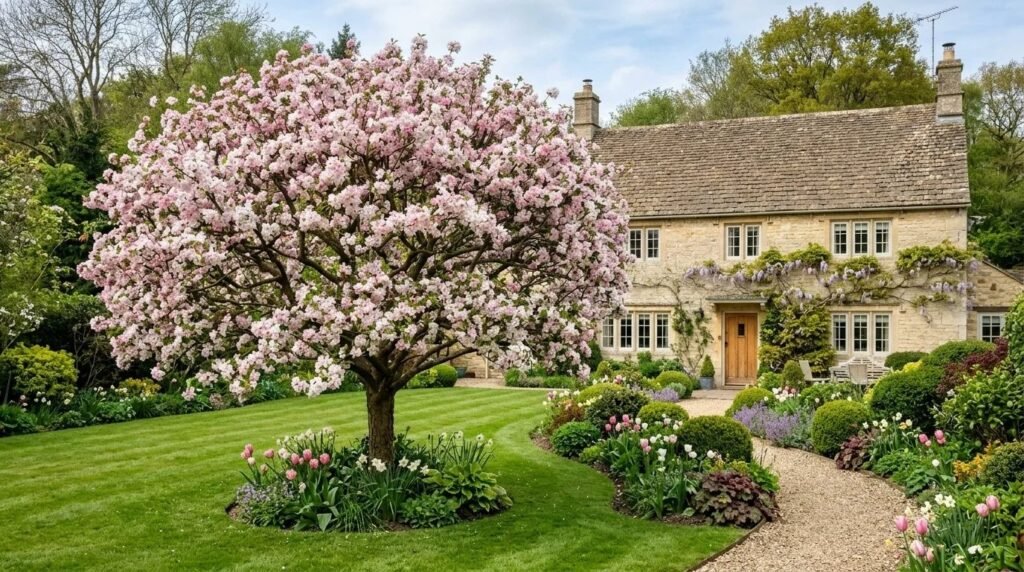
Crabapple trees are appreciated for their spring blossoms and decorative fruits. Depending on the variety, flowers may be white or pink, while small fruits can remain on branches after the flowering season.
A crabapple tree can become a beautiful focal point in a front garden, especially when planted where its blossoms are visible from the house.
Benefits of crabapple:
- Creates a colorful spring display.
- Provides seasonal interest beyond the flowering period.
- May supply food for birds and other wildlife.
- Comes in varieties with different sizes and growth habits.
Crabapples generally need sufficient sunlight for good flowering. Fallen fruit may require additional cleanup, particularly near paths and driveways.
Planting tip: Choose a disease-resistant variety suited to your region and consider its fruiting characteristics before selecting a location.
8. Loquat

Loquat is an evergreen fruit tree that can work well in suitable warm and mild climates. Its large, glossy leaves create a lush appearance, while its fragrant flowers and golden-orange fruit add further interest.
It can be an attractive option for homeowners who want a tree that provides both decorative value and edible fruit.
Why choose loquat?
- Offers evergreen foliage in suitable climates.
- Produces edible fruit.
- Adds a lush appearance to the landscape.
- Can combine ornamental and practical benefits.
Loquat generally prefers well-drained soil and adequate sunlight. Cold weather can damage flowers, fruit, and foliage, depending on the variety and conditions.
Planting tip: Check the climate requirements and mature size. Keep the tree away from heavily used paths if falling fruit would become a maintenance problem.
9. American Hornbeam
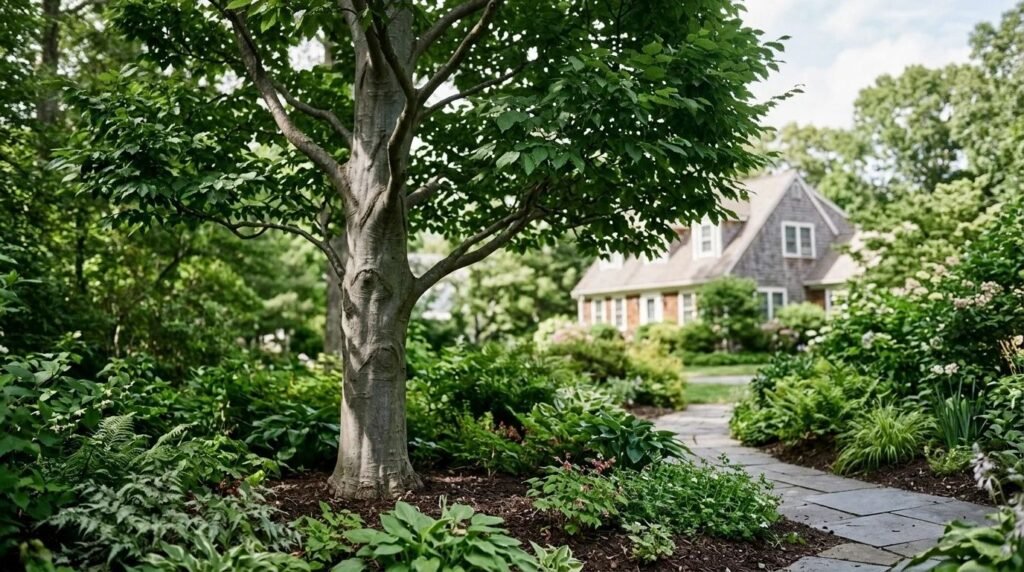
American hornbeam is valued for its smooth gray bark, attractive branching, and seasonal foliage. Its trunk can develop subtle ridges that give it an interesting appearance, especially during the leafless season.
This tree is useful in naturalistic landscapes where a refined structure is more important than showy flowers. It is generally suited to appropriate temperate regions.
Benefits of American hornbeam:
- Adds structure to a residential garden.
- Offers attractive bark and branching.
- Provides seasonal foliage interest.
- Can complement woodland-inspired landscaping.
American hornbeam generally prefers well-drained soil with adequate moisture and can tolerate some shade. Its mature dimensions and suitability should be checked for the planting location.
Planting tip: Make sure the tree has sufficient soil volume and space for its crown to develop without interfering with the house.
10. American Holly
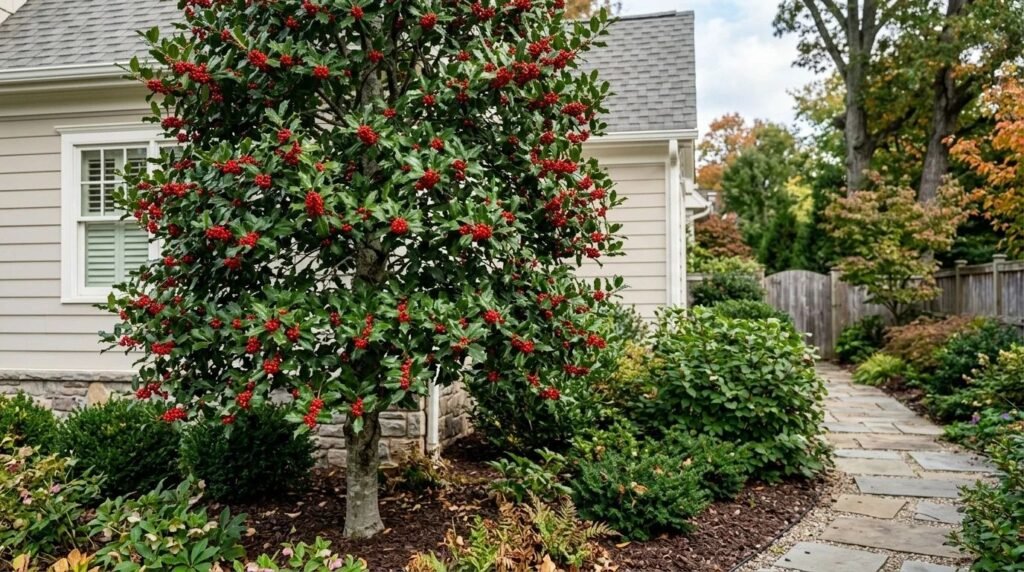
American holly is an evergreen tree known for its glossy leaves and red berries on female plants when suitable pollination occurs. Its foliage can create a green backdrop throughout the year.
It may be useful in landscapes where evergreen structure or visual screening is desired. However, it can grow into a substantial tree and should not automatically be treated as a compact foundation plant.
Why consider American holly?
- Provides year-round foliage in suitable climates.
- Adds seasonal color through its berries.
- Can contribute to privacy screening.
- Offers habitat and food for some wildlife.
American holly generally prefers acidic, well-drained soil and is best suited to appropriate temperate climates.
Planting tip: Check the mature size and pollination requirements of your chosen variety. Keep thorny foliage away from narrow paths and frequently used entrances.
11. Pawpaw

Pawpaw is an unusual fruit tree for homeowners interested in edible landscaping. It produces large leaves and distinctive fruits with a soft texture and tropical flavor when ripe.
Native to parts of eastern North America, pawpaw is best suited to climates and soils that match its requirements. It is not a universal option for hot, dry, or tropical gardens.
Benefits of pawpaw:
- Produces distinctive edible fruit.
- Adds lush foliage to a suitable garden.
- Offers an alternative to common ornamental trees.
- Can form part of a home orchard.
Pawpaw generally prefers moist, well-drained soil and may benefit from protection from harsh conditions while young. Fruit production can depend on compatible pollination partners.
Planting tip: Check local growing suitability and pollination requirements before purchasing a pawpaw tree.
12. Dwarf Citrus Trees

Dwarf citrus trees can be an excellent choice for sunny gardens and patios in suitable climates. Depending on the variety, they can produce lemons, limes, mandarins, or other citrus fruits.
Their compact growth makes them useful for smaller outdoor spaces. Some can also be grown in large containers when provided with adequate sunlight, drainage, and care.
Why plant dwarf citrus?
- Produces fragrant flowers and edible fruit.
- Works in many compact garden designs.
- Can be grown in containers.
- Adds greenery and seasonal color.
Citrus trees generally need plenty of sunlight, suitable drainage, and protection from damaging cold. Different varieties have different temperature tolerances.
Planting tip: Choose a variety suited to your climate and leave enough room for harvesting, watering, and routine maintenance.
13. Olive Tree

Olive trees are known for their silvery-green foliage and distinctive Mediterranean appearance. They can complement modern houses, pale stone pathways, gravel gardens, and landscapes with ornamental grasses.
In suitable climates, an olive tree can become a long-lived feature. Some varieties also produce olives, although fruiting depends on the cultivar, pollination, climate, and growing conditions.
Benefits of olive trees:
- Offers distinctive silvery foliage.
- Suits Mediterranean-inspired landscapes.
- Can tolerate relatively dry conditions once established in suitable soil.
- Provides a strong ornamental focal point.
Olive trees generally prefer full sun and well-drained soil. Cold tolerance varies by cultivar, and persistently wet soil can cause problems.
Planting tip: Confirm that your climate and soil drainage suit the selected variety. Allow room for the mature canopy and consider fruit drop near paths and patios.
14. Saucer Magnolia
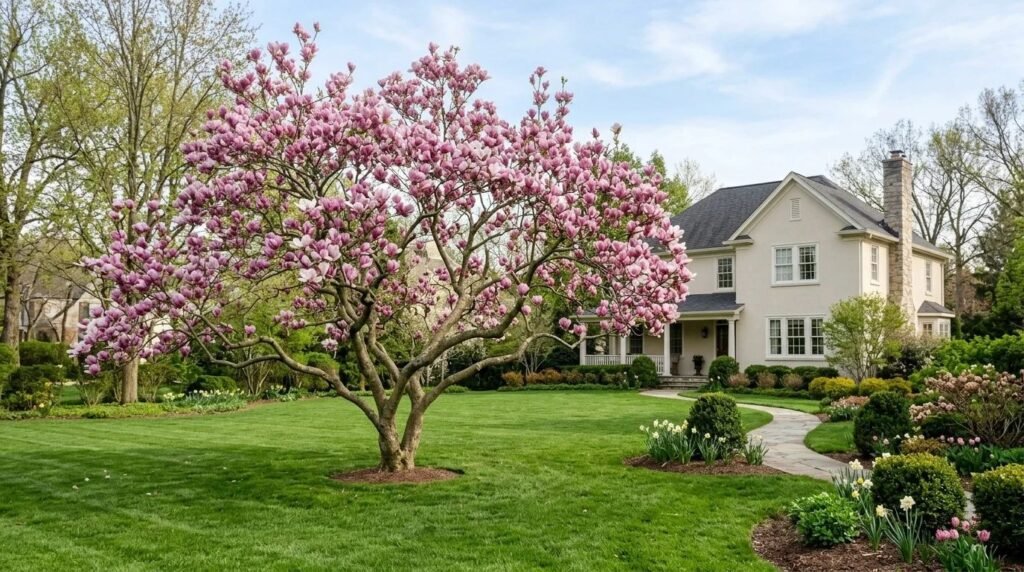
Saucer magnolia is an ornamental tree recognized for its large, showy flowers, which may be pink, purple, or white. Its rounded form can make it a striking centerpiece in a spacious front yard.
Because some varieties develop a broad canopy, saucer magnolia requires more room than its young size may suggest.
Why choose saucer magnolia?
- Produces dramatic seasonal flowers.
- Creates an attractive focal point.
- Works well in spacious ornamental gardens.
- Complements lawns and simple planting beds.
Saucer magnolia generally prefers well-drained soil and suitable growing conditions. Late frost may damage its flowers in some climates.
Planting tip: Avoid placing it in a narrow strip beside the foundation. Choose an open location where its mature branches can develop naturally.
15. Columnar Hornbeam
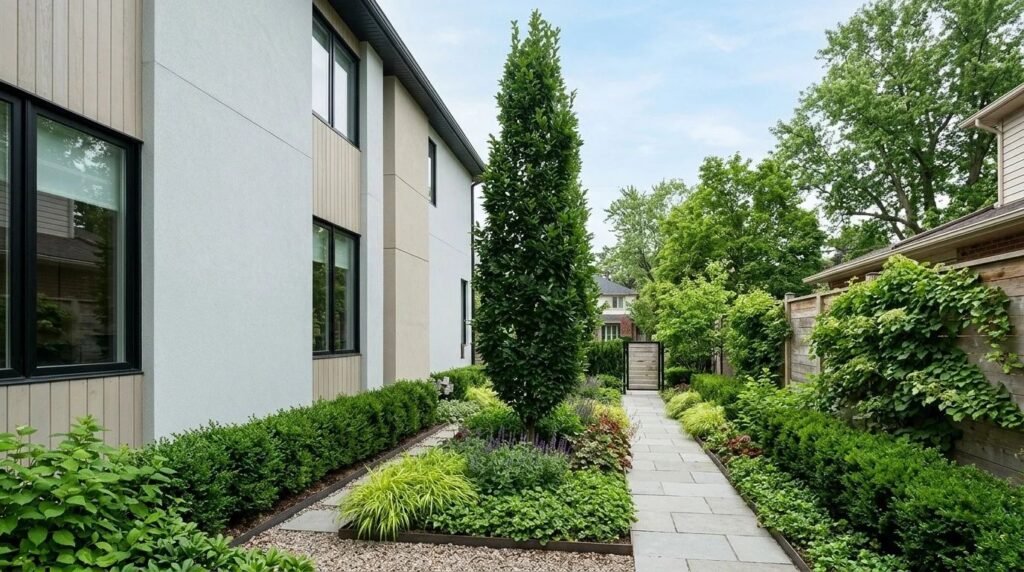
Columnar hornbeam is worth considering when you want an upright tree that takes up less horizontal space than a broad, spreading variety. It can suit narrow side gardens, formal entrances, and landscapes that need vertical structure.
The exact mature size depends on the cultivar, so it is important to verify the expected height and width before planting.
Benefits of columnar hornbeam:
- Offers a relatively upright growth habit.
- Can suit narrow planting areas.
- Adds structure to formal landscaping.
- Provides seasonal foliage and branching interest.
Although its crown may be narrow, the tree still needs sufficient soil volume and room for its roots. Branches also require clearance from walls, roofs, and overhead utilities.
Planting tip: Choose a cultivar that fits the available space at maturity rather than relying on its young nursery shape.
Good Trees to Plant Near House Based on Your Landscaping Needs
Not every homeowner wants the same result from a tree. Some want a colorful front garden, others need shade for a patio, and some prefer evergreen greenery or edible fruit.
Choosing a tree based on your main goal can make the decision much easier.
Best Trees for a Beautiful Front Yard
For front-yard landscaping, ornamental trees with attractive flowers or foliage can create a welcoming first impression.
Japanese maple is worth considering for its colorful foliage, while Eastern redbud and flowering dogwood can provide seasonal flowers in suitable climates. Star magnolia may also be a good choice where its growing requirements are met.
Think about the relationship between the tree and your home’s exterior. A tree with a graceful canopy may complement a traditional house, while a narrow-growing cultivar may suit a more structured modern landscape.
Best Trees for Shade
If your main goal is to create shade, focus on the mature canopy rather than flower color or decorative features.
A tree with a broad canopy may provide more shade than a small ornamental variety, but it will also need more space. Consider the direction of sunlight, the area you want to shade, and whether you want sunlight to reach the windows during winter.
Choose a species suited to your local climate and allow enough distance from the house for its mature branches.
Best Trees for Privacy
Evergreen trees can help create visual screening throughout the year. American holly is one possible option in suitable temperate regions, while other evergreen varieties may be more appropriate for different climates.
Check the mature height, width, and density of the tree. If you have limited space, a suitable narrow-growing cultivar may be more practical than a broad evergreen tree.
Best Trees for Small Gardens
Small gardens benefit from trees that fit their surroundings without dominating the available space.
Japanese maple, compact flowering dogwood, and appropriately sized redbud cultivars are options to investigate in suitable regions.
Remember that the term “small tree” does not mean the tree can be planted immediately beside a foundation. Mature canopy size, root conditions, and the space available for maintenance still matter.
Best Trees for Fruit and Practical Benefits
If you want an edible garden, consider suitable fruit trees such as dwarf citrus or loquat in climates where they grow well. Pawpaw may be another option in appropriate temperate regions.
Fruit trees require additional consideration because fallen fruit can attract insects, stain paving, or create slippery surfaces. Make sure the tree has sufficient sunlight, drainage, and room for harvesting.
Trees Around House: How to Plan Your Landscape
Planting trees around house exteriors can make a property feel more welcoming and visually balanced. However, the most successful landscapes are planned around the mature size of each tree rather than the number of plants that can fit into the garden today.
Start by looking at the different areas around your property.
Front entrance: A compact ornamental tree can frame the entrance and soften the appearance of hard surfaces. Keep branches away from doors, windows, and walkways.
Side of the house: Narrow spaces may suit appropriately selected upright trees or smaller ornamental varieties. Check the available soil volume, overhead clearance, and distance from the foundation.
Backyard: A larger planting area may allow a shade tree, a fruit tree, or a combination of trees and shrubs. Position trees according to sunlight, privacy, and the intended use of the outdoor space.
Patio and seating area: Consider canopy spread, falling leaves, fruit, and branches before planting. The tree should provide the desired visual effect without making the area difficult to maintain.
Property boundaries: Check mature width and consider neighboring structures, fences, utilities, and local planting rules.
For a cohesive design, combine trees with lower-growing shrubs, ground cover, and suitable garden paths. Leaving some open space around each tree can help it become a natural focal point.
Best Trees to Plant Next to House: What to Consider Before Planting
If you are looking for the best trees to plant next to house walls or foundations, choosing the right location is just as important as choosing the right species.
A tree’s roots do not generally break through a sound foundation simply because they are nearby. However, roots may enter leaking drains, affect paving, or contribute to soil movement under certain conditions. Large trees can also develop branches that interfere with roofs and gutters.
Before planting, consider these factors.
1. Mature Height and Canopy Spread
Check the expected height and crown width of the specific species and cultivar. A tree that fits comfortably in a planting bed today may become too large as it matures.
Allow adequate room for the branches to grow without rubbing against the exterior or obstructing gutters and windows.
2. Root Growth and Soil Conditions
Roots need water, oxygen, and sufficient soil volume. Their growth patterns depend on the species, soil structure, moisture, and available space.
Clay soils can be especially important when assessing potential building movement because changes in soil moisture may cause some clay soils to shrink or swell.
If your property has a history of foundation movement or drainage problems, seek professional advice before planting a substantial tree nearby.
3. Underground Pipes and Utilities
Identify underground utilities before digging. Consider the location and condition of drains, water pipes, and other infrastructure.
Roots may exploit existing leaks or damaged pipes. Do not assume that a tree with a small trunk will remain harmless to nearby infrastructure as it grows.
4. Maintenance and Branch Clearance
Branches that grow against walls or roofs can create maintenance problems. Fallen leaves, fruit, and twigs may also accumulate in gutters or on paths.
Choose a tree that fits the available space naturally rather than relying on repeated severe pruning to control its size.
5. Local Climate and Growing Conditions
A tree that is well suited to one region may struggle in another. Temperature, rainfall, humidity, soil drainage, and sunlight all influence its health.
Select a species known to thrive in your local area, and confirm its mature dimensions before planting.
For additional guidance on trees near buildings, consult the Royal Horticultural Society: https://www.rhs.org.uk/plants/types/trees/near-buildings.
How Far Should Trees Be Planted From a House?
There is no single planting distance that is appropriate for every tree. The recommended spacing depends on mature size, growth habits, soil conditions, foundation characteristics, and the location of nearby utilities.
A compact ornamental tree and a large shade tree should not automatically be planted at the same distance from a building.
Before planting, research the specific species and consider the following:
- Mature crown: Leave sufficient space for branches to grow without obstructing the house.
- Rooting environment: Consider soil type, available soil volume, drainage, and nearby infrastructure.
- Foundation conditions: If the property has a history of structural movement, obtain suitable professional advice.
- Utilities: Locate underground pipes and overhead lines before deciding where to dig.
- Maintenance access: Leave room to inspect and maintain the building and tree safely.
Avoid relying on a universal distance chart without considering the actual site. Where foundation or drainage risks are significant, a qualified arborist or appropriate building professional can help assess the property.
Trees You Should Avoid Planting Too Close to Your House
Some trees are unsuitable for certain planting locations because of their size, water needs, branch structure, or maintenance requirements.
Rather than assuming an entire species is dangerous, evaluate the tree and the conditions around your property.
Large Trees in Narrow Planting Beds
A large tree may eventually outgrow a narrow strip beside a wall or driveway. Its branches may interfere with the building, while its roots require more space than the planting area can provide.
Choose a smaller or more upright variety if the site is restricted.
Trees With Extensive Water Requirements in Unsuitable Soil
Some species need consistently moist soil, while others tolerate dry conditions once established. A tree planted in an unsuitable location may struggle or require more watering than expected.
Match the tree to your local rainfall, soil drainage, and climate.
Fruit Trees Beside Frequently Used Walkways
Fruit can fall onto paving, attract insects, or create slippery surfaces. If you want to plant an edible tree, consider placing it away from entrances and frequently used paths.
Tall Trees Beneath Overhead Wires
Avoid planting a tree where its mature height will conflict with utility lines. Choose a species that can fit safely within the available space.
Trees Near Damaged Drains or Vulnerable Paving
Roots may exploit leaking pipes and can sometimes affect nearby paved surfaces. Inspect the area before planting, and account for the mature tree’s size and growing conditions.
The aim is not to avoid planting trees around your home. It is to select trees that can thrive in the available space without creating unnecessary maintenance or structural concerns.
How to Choose the Right Tree for Your Home
Before purchasing a tree, assess your garden and decide what you want it to achieve.
Measure the Available Space
Measure the planting area and compare it with the tree’s mature height and spread. Consider nearby walls, windows, driveways, walkways, and property boundaries.
Remember that roots may extend beyond the visible canopy, so sufficient soil volume is important.
Check Your Climate
Find out whether the tree is suited to your local temperatures, rainfall, humidity, and seasonal conditions.
Some ornamental trees prefer cooler climates, while subtropical fruit trees need warmer conditions. Choose a species that is known to grow well in your region.
Understand Sunlight and Soil Drainage
Observe how much direct sunlight reaches the planting area. Some trees flower best in full sun, while others prefer partial shade.
Check whether water drains properly after rainfall. Persistently waterlogged soil can damage roots, while very dry soil may be unsuitable for moisture-loving species.
Choose Your Main Purpose
Decide whether you want shade, privacy, flowers, decorative foliage, or edible fruit. Your main goal will help narrow down the available options.
For example, a compact ornamental tree may suit a small front garden, while a broad-canopied tree may be more appropriate for a spacious yard where shade is the priority.
Consider Long-Term Maintenance
All newly planted trees require attention while they establish. Depending on the species, care may include watering, mulching, pruning, and monitoring for pests or disease.
Choose a tree whose maintenance needs fit your available time and resources.
Inspect the Tree Before Buying
Look for a healthy trunk, well-distributed branches, and no obvious signs of serious damage or disease. Ask the nursery about the tree’s mature dimensions and growing requirements.
A healthy tree planted in an appropriate location has a better chance of establishing successfully.
Frequently Asked Questions
What are the best trees to plant near a house?
The best trees to plant near a house depend on the available space, climate, soil, and landscaping goals. Japanese maple, flowering dogwood, and Eastern redbud can be attractive ornamental choices in suitable regions. For shade, privacy, or fruit, choose species that match those specific needs.
What are good trees to plant near house foundations?
Compact ornamental trees may be suitable for some foundation planting areas, but there is no universally safe tree for every foundation. Check the mature dimensions, root characteristics, soil conditions, drainage, and foundation requirements before planting.
Which trees are best to plant next to a house?
The best trees to plant next to a house are those that fit the available space at maturity and suit the local climate. Smaller ornamental cultivars may work in some locations, while larger trees need more room. Do not select a tree based on its young size alone.
Can tree roots damage a house foundation?
Tree roots do not generally penetrate sound foundations directly, but roots can enter leaking drains and interfere with paving. In certain soil conditions, changes in moisture caused by tree growth can also contribute to ground movement. The actual risk depends on the tree, soil, foundation, and site.
What are the best small trees for the front of a house?
Japanese maple, flowering dogwood, Eastern redbud, and appropriately sized magnolia cultivars are worth considering in suitable climates. Check the mature height and canopy spread to ensure the tree will fit the front garden.
Which trees are best for shade around a house?
The best shade tree depends on how much space you have and where you want the shade. Trees with broader canopies may provide more coverage, but they generally need more room. Consider the direction of sunlight and the mature size of the species before planting.
Are evergreen trees good for planting around a house?
Evergreen trees can provide year-round foliage and screening, but they still need adequate room for mature growth. Check their height, width, root environment, and suitability for your climate before planting.
Can I plant fruit trees near my house?
Yes, provided the selected fruit tree suits the climate and has enough room to grow. Consider sunlight, mature size, fruit drop, drainage, and access for harvesting. Avoid placing fruit trees where fallen fruit will create problems on heavily used paths.
When is the best time to plant a tree?
The best planting season depends on the species and local climate. In many temperate regions, planting during dormancy is beneficial, while in warmer climates the ideal time may depend on milder weather and reliable soil moisture. Follow local nursery or horticultural guidance.
Final Thoughts
Choosing the right trees to plant near a house is an investment in your home’s outdoor appearance and long-term landscape. The right species can add colorful flowers, attractive foliage, useful shade, evergreen screening, or even edible fruit.
Start by identifying your main goal, measuring the available space, and researching the tree’s mature size and growing requirements. Consider the local climate, soil drainage, foundation conditions, and nearby utilities before deciding where to plant.
Whether you prefer a Japanese maple in a compact ornamental garden, a flowering tree in the front yard, or an appropriate fruit tree in a sunny backyard, careful planning will help you create a more attractive and functional landscape.
The best tree is not necessarily the largest or most colorful one. It is the tree that suits your property, grows well in your climate, and has enough room to thrive for years to come.